Monday, September 17, 2012

The healing power of Comfrey!


Don’t leave home without her……….Comfrey!
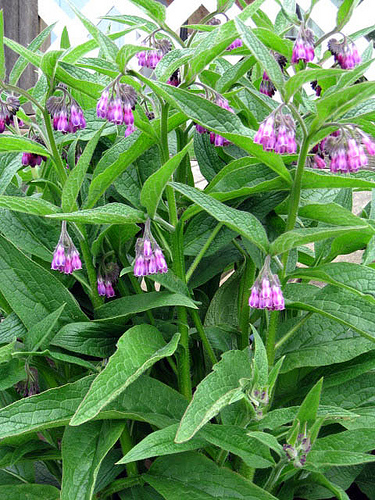
     Comfrey (Symphytum Uplandicum)

Whenever there is an injury, think Comfrey!  She is a miraculous healer.  Comfrey helps to mend broken bones, strained or torn muscles and ligaments, and heal wounds.   And it works fast……..

I was given a 3 inch piece of root by a farmer who told me to break it into 4 pieces and plant them separately.  I now have 4 enormous, beautiful comfrey plants!  That is how quickly it regenerates itself and us!

In fact it works so quickly on a wound that you want to make sure there is no infection or dirt inside before applying the plant because it will immediately begin to heal the skin.

·        Comfrey is also known as "knitbone," and no better ally for the woman with thin bones can be found
·        Comfrey contains special proteins used in the formation of short-term memory cells
·        It soothes and strengthens both digestion and elimination
·        Keeps wrinkles at bay and the skin and scalp soft and supple
·       She is loaded with calcium, chromium, potassium, amino acids and Vitamin A and D
·       Its soothing mucilage adds flexibility to joints, eyes, pelvis and lungs.
·        Rich in protein and folic acid
·        Helps to heal injured or torn muscles or ligaments
·        Helps to heal lung tissue
·       Her anti-inflammatory nature, can aid in cases of arthritis

There has been debate on the effects of Comfrey on the liver.  Comfrey contains alkaloids and a study was done injecting the compound over time from the roots into rats and there were some that showed liver damage.  However the test was done only with the “roots” and not the leaves used in infusion, and the amounts were extremely large.  Here is what my teacher Susun says:
And then the last one is an herb that I have used very consistently for more than a quarter of a century, and that’s Comfrey Leaf.  Some people feel that Comfrey is not safe to use during pregnancy. Some people feel comfrey is not safe to use internally at all. I disagree. The roots of comfrey do contain compounds that are best avoided during pregnancy. (As do all parts of the wild plant.) In fact, I rarely use comfrey root because of the possibility of liver congestion, and I strongly caution those who have had hepatitis, chemotherapy, or alcohol problems to strictly avoid comfrey root. Yet even these people can benefit from use of comfrey leaf infusions. I harvest the flowering stalks when they are fully formed; and I am careful to use the cultivated garden comfrey, which grows very tall and has purplish, pinkish, bluish flowers. I avoid wild comfrey which stays rather small, even when flowering, and has cream-colored, white, or yellowish flowers.

Comfrey (Symphytum) leaf is free of the compounds (PAs) found in the root that can damage the liver. I have used comfrey leaf infusion regularly for decades with no liver problems, ditto for the group of people at the Henry Doubleday Research Foundation who have eaten cooked comfrey leaves as a vegetable for four generations.

With all of that said, I am currently drinking a quart of comfrey about every 10 days, as I rotate it with my other herbs.   This week I was struggling with a shoulder pull and felt tender in my ankle and wrist, so chose to drink if for 3 days in a row.  This is all about listening to our own body and taking charge of our own health. 

How would I make an infusion of Comfrey?  The same way that is used for most infusions.  Put 1 ounce of the dried herb in a glass quart canning jar.  Pour boiling water into the jar to cover the herb and fill it up to the very top.  Screw on the lid and let sit for between 4 and 10 hours.  Then strain out the herb – I pour the whole jar into a mesh reusable produce bag, over a bowl or sauce pan.  Then I close the bag around the herb and squeeze out  all of the remaining liquid.  Finally  pour all of the liquid back into the canning jar.  Refrigerate.  Drink over ice within 2 to 2 ½ days. 

How does she taste?  Like a black tea, but because of the mucilage her texture is a little thicker.  If you aren’t a black tea drinker, you can also mix in a pinch of dried peppermint when making the infusion to make it very refreshing.   I like the taste just as she is!

Great for the muscles,  the lungs, digestion and skin!

Nourishing myself from the inside,
SARAH

A quiet confident friend.....Red Clover


We all know her, and have probably weeded her out of the yard, but let’s meet her again with a fresh perspective…….Red Clover!

     Red Clover (Trifolium pratense)


To begin, Red Clover is the best cancer preventative and cancer curative herb!
·       Very high in phyto-sterols which turn into estrogen, progesterone or any hormone that the body needs
·        Red clover is a source of many valuable nutrients including calcium, chromium, magnesium, niacin, phosphorus, potassium, thiamine, and vitamin C.
·        Single most effective herb to establish fertility (combine with Ms Oatstraw)
·        Reduces possibility of forming blood clots and arterial plaques and may increase LDL (good cholesterol)
·        Red clover has the ability to reduce inflammation in the lungs, calm bronchial spasms, and aid in asthma
·        Can help alleviate hot flashes, lesson symptoms of PMS, and support breast health
·        Has been shown to limit development of benign prostate hyperplasia (enlarged prostate) and may block enzymes that contribute to prostate cancer
·        Can help with skin conditions such as psoriasis and eczema
·        Naturally blood purifying
Women with hormone-dependent conditions such as endometriosis, uterine fibroids, and cancers of the breast, ovaries, or uterus should not take red clover due to its possible estrogenic effects. Men with prostate cancer should also avoid taking red clover, unless a doctor recommends using it.
Red Clover infusion is made only from the blossoms, which are also good sprinkled in a salad!  Who would have known!
How would I make an infusion of Red Clover?  The same way that is used for most infusions.  Put 1 ounce of the dried herb in a glass quart canning jar.  Pour boiling water into the jar to cover the herb and fill it up to the very top.  Screw on the lid and let sit for between 4 and 10 hours.  Then strain out the herb – I pour the whole jar, herb and all, into a mesh reusable produce bag, over a bowl or sauce pan.  Then I close the bag around the herb and squeeze out  all of the remaining liquid.  Then pour all of the liquid back into the canning jar.  Refrigerate.  Drink over ice within 2 to 2 ½ days. 
 
How does she taste?  Like a black tea.  If you aren’t a black tea drinker, you can also mix in a pinch of dried peppermint when making the infusion to make it very refreshing.
Good for the blood, the lungs, the bones and the reproductive system!
 
Nourishing myself from the inside,
SARAH


And now........Oatstraw!


And next let me introduce you to  my laid back, flexible, soothing friend……Oatstraw!
 
Oatstraw (Avena Sativa)

Oatstraw is the remaining part of the oat plant once the grain has been harvested.  Typically the dried herb used for infusions is the milky green tops.  As Avena, she is what is put in many soothing bath and skin products. 

Oatstraw is someone you will want to hang out with.    She is calming……she is moisturizing…. She brings back aliveness!
·         Reduces cholesterol levels and risk of heart disease and diminishes heart rate disturbances such as palpitations
·         A wonderful ally in a stressful day as she nourishes strong nerves and stabilizes moods – keeping you from “flying off the handle”
·         Increases libido
·         Helps to alleviate dryness in the body - particularly good for post-menopausal, bringing back the juiciness!
·         Helps to calm the nervous system and fight depression and anxiety
·         An excellent source of Vitamin B complex
·         Like her sister Nettle, a cup of oatstraw infusion contains more than 300 milligrams of calcium plus generous amounts of many other minerals for strong bones, teeth and nails
·         Oatstraw’s steroidal saponins nourish the pancreas and liver, improving digestion
·         A wonderful aid in fertility
·         Helps restore restful sleep patterns
·         Can help reduce frequency and duration of headaches and alleviate joint pain
How would I make an infusion of oatstraw?  The same way that is used for most infusions.  Put 1 ounce of the dried herb in a glass quart canning jar.  Pour boiling water into the jar to cover the herb and fill it up to the very top.  Screw on the lid and let sit for between 4 and 10 hours.  Then strain out the herb – I pour the whole jar, herb and all, into a mesh reusable produce bag, over a bowl or sauce pan.  Then squeeze out  all of the remaining liquid from the herb thats in the bag.  Then pour all of the liquid back into the canning jar.  Refrigerate.  Drink within 2 to 2 ½ days.  The herb can then be thrown in your yard or garden to finish it's life cycle!

How does she taste?  Delicious!  Very mild and soft, just like her personality!

Here, here for Oatstraw!

Nourishing myself from the inside,
SARAH
 

Friday, September 14, 2012

Meet Stinging Nettle!


Yogis,

Allow me to introduce you to Ms Stinging Nettles!
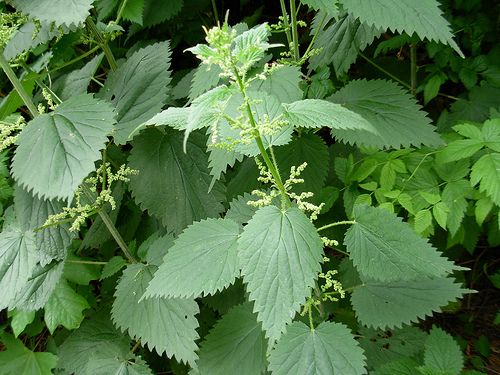
     Stinging Nettle (Urtica Dioica)

 Many of you may have already met her without a formal introduction.  Have you ever felt like you were stung while walking off path down on the canal or in the woods?   That was probably her saying hello.    She has many hollow stinging hairs on her leaves and stem that when brought in contact with the skin will inject histamines, causing a stinging or burning sensation.  The sensation will come and go over several hours.  I would describe it as the feeling you have if you touch a small cactus and have some of those tiny hairs stuck in your skin.  You may even get small welts that disappear quickly. 

I was first introduced to her in the backyard of an herbalist 4 years ago.  After hearing about the sting and being told to always wear gloves when working with her, I decided to keep my distance!  It wasn’t until 2 years later that I became curious again – allowing myself to be stung, transplanting a few in my yard to start my own nettle patch, and sautéing a large bunch of the leaves with sesame oil and garlic for dinner.  And boy am I glad I did!!

Nettle is an all over body tonic.  She has a long history of medicinal uses and is one of the most valuable herbal remedies.  Here are some of her main healing qualities:

·        Unlike caffeine which provides a short burst of activity, nettle slowly builds long
term energy – combating anemia and fatigue
·        Strengthens the adrenals, thereby reducing anxiety
·        A complete tonic to restore healthy functioning of the kidneys
·        Nettle’s iron helps to restores youthful flexibility to blood vessels and is an excellent blood builder
·        Helps prevent or possibly even reverse osteoporosis.  A cup of nettle infusion contains 500 milligrams of calcium plus generous amounts of bone-building magnesium, potassium, silicon, boron, and zinc
·        Excellent source of vitamins A, D, E, and K
·        Her histamines actually act as an anti-histamine in the body, helping to  alleviate seasonal allergies and reduce inflammation in the body
·        In some studies it has been shown to help as an aid in weight loss
·        Nettle leaf is effective at reducing symptoms of the digestive tract ranging from acid reflux, excess gas, nausea, colitis and Celiac disease
·        For flexible bones, a healthy heart, thick hair, beautiful skin, and lots of energy, make friends with sister stinging nettle.

Here is what one webs site has to say:
It may be a brash statement to say that one prickly green herb is the panacea for almost everything that ails you; but, in the case of stinging nettles, it's mostly true. If there's one plant to have on hand at all times that provides a cure for arthritis, an herbal treatment for allergies, relieves hair loss, treats Celiac disease, bleeding, bladder infections, skin complaints, neurological disorders and a long list of other conditions -- it's nettle leaf.

So what does she taste like?  Earthy.   When I first started drinking her infusion I was a little challenged to drink  a full ½ quart in  a day.  But I gave it time and now I crave her.   You can just feel health seeping in with each swig.  The taste is toward that of a darker green tea.

How often should I drink it?  That is really a personal decision.  I drink 2 quarts a week.  I make a quart and drink over two days, then drink 2 days of another herb, and then back to two days of stinging nettle.

Do I drink it cold or room temperature?  It tastes best to me over ice.  If you don’t find the taste appealing at first, you can add a little salt or lemon or milk.  I drink my plain over a lot of ice.    I use my water bottle so she can just go with me!

And if you have some left over after two days, she is even a wonderful hair rinse!

Glad to have a relationship with Stinging Nettles,
SARAH


Tuesday, September 4, 2012

August and Nourishment


Breathing Yogis,
Receiving the breath in the belly – massaging the digestive organs and clearing anxiety and stress
        Expanding the ribs as the breath rises – removing  the layers of armor to let ourselves be seen
              Finally filling the upper chest  with breath – giving the heart space to bloom…the breath of surrender

And then letting it all go. Not holding anything back.  Trusting the you will be filled again, and again, and again.

This week in the women’s classes we talked about cycles and our connection to earth as the feminine.  Our three stages of life – Maiden, Mother and Crone (and proud to be one!).  And our monthly moon cycles.   (sorry men, didn’t want to completely send you over the edge)  Honoring all of it.  Connecting to that inner knowing and remembering.

And now we all begin to enter this seasonal cycle of late summer as it carries us toward fall.  The season of the harvest.  Bountiful.    Above is my personal harvest from the back yard today.  Grateful.  Nourishing for the body and soul.  Late August, with all of its color, warmth and never ending hum in the air makes me feel like I am getting a giant bear hug!  Go outside, close your eyes and give in to its embrace.

In my last note I mentioned Nourishing Herbal Infusions and I spoke more about them in classes.  So what is the difference between tea and an infusion??  Tea is about a teaspoon of herb, soaked for about 3-5 minutes.  An infusion is a full ounce of herb soaked for between 4 and 10 hours!

Why would I want to drink them?  Because they will allow you to throw away your supplements (what a waste since they are so expensive) and over time remove yourself from many medications.

What are some of the potential benefits?  Lower cholesterol, increased bone density (preventing or even reversing osteoporosis), cancer prevention, stronger teeth and nails, shinier hair, smoother skin, improved circulation and heart health, reduced wrinkles, increased libido….just to name a few of them.

What are the first 4 herbs we might want to consider for our infusions?  Stinging nettles, Comfrey, Red Clover Blossoms and Oatstraw

What would I need to have?  (2) quart size glass mason/canning jars, a mesh reusable produce bag (Crate and Barrel and Amazon sell nice ones) and a small electronic scale.  All very inexpensive items.  Oh, and of course the dried herb.  I place orders for herbs from Frontier about every 6 weeks.

So what if I am interested?  If you live in my area I  would be happy to have you come by and watch the process, see what I use and have a taste testing.   For those not in the area or who can’t come over, I written directions and links to You Tubes on my web site . 

How can I find out more about the specific herbs?  Descriptions, uses and benefits for the four herbs are all here on this site.  I would also ask you to do some research on your own and I can recommend some sites. 

This is all about taking back control over our bodies and our health.  Healing ourselves naturally from the inside.  We are the expert but we have to trust our inner guidance and nourish ourselves.   This is the Wise Woman Tradition.    I hope many of you join me on this next leg in our journey!

Drinking my Stinging nettle today……yum.
SARAH

Monday, August 27, 2012

....my week with Susun


  Susun Weed    www.susunweed.com

I spent August 6-12 at Laughing Rock, Susun Weed’s property/home in Woodstock NY for the Green Goddess Apprentice Intensive.    And I have so much to share.  Today I will give a broad overview of my week.  Over time I want to share many of the Susun’s philosophies and usable daily tips on health, nourishment, the feminine and connection to Mother Earth. 

It was challenging physically, mentally and emotionally and took me far outside of my comfort zone box.  And as I always say –“ if you are comfortable, you aren’t growing”.   Well I was given lots of space for growth!!

I slept in my tent the whole week.  Only got one shower.  Took out my contacts.  Was outside and barefoot almost all day.  I fell asleep to the owls and awoke each morning to the sunrise and the chirp of the titmouse.  Yarrow tincture on our feet and ankles each morning to deter ticks and mosquitos.  3 wonderful nourishing meals each day….no white sugar or white flour.  No snacking, other than a wild plant here and there.   All we drank from morning to night were nourishing herbal infusions (much more on that to come!!), with the exception of a 5 year old bottle of homemade dandelion wine that she opened for us one evening….delicious! 

Our days were structured around the schedule of the goats as they are free range so must be watched.  They were milked at 9 and then let out.  Wherever they wandered, we went and then sat for lessons on  the wild plants….weeds as they are known to many.  Did you know that you can crumble Queen Anne’s Lace flowers in your salad?  And that the young leaves of Virginia Creeper, five fingered ivy, make an excellent addition to your salad greens?  Or that the needles from a white pine tree make a delicious vinegar?

Our mornings began with a 7 directional movement meditation that I would love to teach you all, led by Whitefeather.  What a beautiful way to welcome in each new day.  In the afternoons we spent some time beading our power shields.  In the evenings we had different events and rituals – yoga, watching Susun give free phone consultations, a Moon Lodge, a Goddess pageant and one night we kept a heart beat drum going from 8pm to 6:30 am, each taking 2 hour shifts and sleeping around the fire in between.   And all done with 6 other beautiful women ranging in age from 27 to 62. 

Susun is a unique individual.  Strong, extremely intelligent, passionate, controversial, driven by what she believes in, tough, caring, and a wonderful story teller.  She pushes….hard.  She screams… a lot.  But she also hugs.  I realized that being around her makes you stay present.  She is who she is and makes it clear that you don’t have to like her.  She just wants you to learn from her and carry it back to share. 

By the end of the week my feet were earth stained, my skin felt smooth, my hair was close to starting on dreadlocks, and I felt so alive.  So full.   So connected.  And the effects of the week continue to unfold inside of me. 

Bringing my heartbeat in rhythm with the earth’s,
SARAH